5 Ingredients for Wellbeing
PERMA Explained
It is a question that sits at the heart of Positive Psychology.
Traditionally, much of psychology has focused on understanding psychological difficulties and finding ways to reduce distress. These developments have been enormously important, but Positive Psychology asks us to consider another equally important question: what helps people live well?
Seligman and Csikszentmihalyi (2000) described Positive Psychology as the scientific study of positive experiences, individual strengths and the conditions that enable people and communities to thrive. Rather than focusing solely on what is wrong or what needs fixing, Positive Psychology also explores what helps us build lives that are meaningful, satisfying and worth living.
But flourishing is about much more than simply being happy.
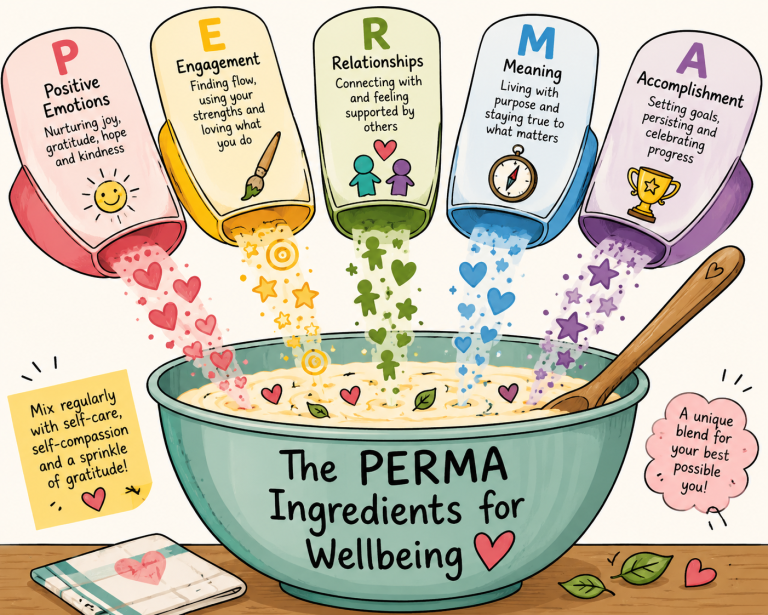
In his theory of well-being, Seligman (2011) proposed five measurable elements that contribute to our sense of well-being: Positive Emotion, Engagement, Relationships, Meaning and Accomplishment. Together, they form the acronym PERMA.
Think of PERMA as five different ingredients.
We don’t necessarily need equal measures of each, and there is no single recipe for a good life. What nourishes one person may be quite different from what nourishes another.
It isn’t about telling you how you should live your life.
It is about helping you understand yourself a little better and explore what might help you flourish.
Positive emotion play an important role in psychological wellbeing and human flourishing,it is more than simply ‘just happiness’. Fredrickson’s (2001) research suggests that experiences such as joy, gratitude, interest and hope can do more than simply make us feel good in the moment; they can expand the way we think, respond and engage with the world around us.
Importantly, positive emotions can also be developed and strengthen over time.
Wellbeing isn’t necessarily about waiting for positive emotions to happen. We can become more intentional about noticing and appreciating the good moments, as well as using our imagination to picture positive possibilities for the future.
Over time, these experiences can help influence our habitual ways of thinking and behaving. Research by Tugade and Fredrickson (2004) also suggests that positive emotions can help us recover from stressful experiences and support the development of psychological resilience.
So as part of coaching, we might explore:
Together, we can explore small, realistic ways of creating more opportunities for these experiences — not by ignoring the difficult parts of life, but by making space for the things that help you feel good, connected and able to cope.
Engagement is about becoming deeply involved in something that captures your attention. This connects closely with Csikszentmihalyi’s (1989) concept of flow, those occasions when we become so absorbed in what we are doing that we lose awareness of ourselves and everything around us seems to fade into the background.
Think about a time when you were completely engrossed in something you enjoyed. Perhaps you were painting, gardening, exercising, working on a project, playing music or even having a really absorbing conversation. You may have looked at the clock afterwards and wondered where the time had gone.
That is the kind of experience Positive Psychology refers to as flow.
Flow is more likely to occur when an activity provides enough challenge to hold our attention, while still feeling within our capabilities. In other words, we are stretched without feeling completely overwhelmed (Csikszentmihalyi & LeFevre, 1989).
Our character strengths can play an important role here too.
When we have opportunities to use the strengths we naturally draw on, we may be more likely to experience a sense of engagement and fulfilment. In one study, participants who were encouraged to use their character strengths in new ways each day reported greater happiness and lower levels of depression, with benefits still evident at six-month follow-up (Seligman, Steen, Park, & Peterson, 2005).
So, engagement isn’t simply about trying to make ourselves feel happier. It is about being fully absorbed in something that matters to us, using our abilities and strengths, and experiencing those moments when we are completely ‘in the zone’.
And interestingly, happiness may be one of the positive outcomes that emerges naturally from being more fully engaged in life.
In coaching, we might explore:
Exploring these experiences can help us identify where you naturally experience flow, what strengths you are drawing upon, and whether there are opportunities to bring more of these activities into your everyday life.
We don’t flourish in isolation.
Relationships are an important part of wellbeing because humans are naturally social beings. Feeling connected to other people can give us a sense of belonging, support and security (Seligman, 2012).
When we think about relationships, we might immediately think about partners, family or close friends. But connection can take many forms. It might be a trusted colleague, a neighbour, a community group, or simply someone who makes us feel seen, heard and accepted.
The quality of our relationships matters too. It isn’t necessarily about having a huge social circle; sometimes a few genuine and supportive connections can be far more valuable than lots of superficial ones.
Research has linked stronger social connections with a range of positive outcomes, including better physical health and protection against cognitive decline as we age (Siedlecki et al., 2014).
Positive relationships are also something we can actively nurture. Sharing good news, celebrating someone else’s successes, showing genuine interest in their lives or responding with enthusiasm when they reach out can all help strengthen our connections.
These small moments of positive interaction can contribute to greater intimacy, relationship satisfaction and wellbeing.
Sometimes flourishing isn’t about finding more people. It is about nurturing the relationships that matter, creating healthier connections and making sure we have people around us with whom we can genuinely be ourselves.
In coaching, we might explore:
We can look at the relationships that nourish you, as well as any connections or boundaries that may need some attention.
We might also consider whether there are opportunities to strengthen the relationships that are important to you and create more meaningful connection in your everyday life.
Most of us want to feel that our lives matter in some way.
We want to feel connected to something that is important to us and have a sense that what we do has value. In Positive Psychology, meaning involves belonging to, contributing to, or serving something that feels bigger than ourselves (Seligman, 2012).
That doesn’t mean we all need to discover one great purpose in life. Meaning is deeply personal, and it can look very different from one person to another.
For some, it may come through work or family; for others, it might be found in creativity, helping others, community, volunteering, learning, personal growth or a cause they care deeply about.
Our values can provide an important compass. When the things we do are connected to what we genuinely care about, life can feel more purposeful and fulfilling.
This can become particularly important during periods of change or adversity, when we may need to remind ourselves of what really matters and what we want to stand for.
Having a sense of meaning and purpose has been associated with greater life satisfaction and positive aspects of wellbeing. It can also help us maintain a sense of direction when life becomes difficult.
Sometimes, we don’t need to completely change our lives. We may simply need to reconnect with what matters and find ways to bring more of it into the life we already have.
In coaching, we might explore:
This can be particularly valuable when someone feels they’ve lost their direction, is going through a period of change, or finds themselves wondering, “Is this really what I want anymore?”
Exploring meaning can help us reconnect with our values and consider whether the way we are spending our time and energy reflects the things that genuinely matter to us.
It is about having a sense that what we do has value and connects us to something bigger than ourselves — whether that is family, helping others, creativity, work, learning or contributing to our community.
The final element of PERMA is Accomplishment, sometimes described as achievement, mastery or competence. It is about working towards something, making progress and being able to look back and think, “I did that.”
Accomplishment doesn’t necessarily mean achieving something big or impressive. It can be learning a new skill, completing something you’ve been putting off, reaching a personal goal, overcoming a challenge or simply recognising how far you’ve come.
These experiences can build confidence, motivation and a sense of pride in what we are capable of (Seligman, 2012).
Perseverance is an important part of accomplishment, as is having the motivation to keep going when something becomes difficult. However, Positive Psychology also encourages us to think about why we are pursuing our goals.
Accomplishment can contribute more strongly to wellbeing when we are working towards things because they are personally meaningful, rather than simply chasing approval, status or external rewards (Quinn, 2018).
Research suggests that goals connected to intrinsic needs, such as personal growth, meaningful relationships and contribution, can be more beneficial to wellbeing than goals focused primarily on external rewards such as money, status or recognition (Seligman, 2013).
In coaching, this gives us an opportunity to look beyond “What do you want to achieve?” and ask: “Why does this matter to you?”
We can explore what you want to accomplish, what might be getting in the way, and what strengths you already have that could help you move forward. We can also learn to recognise progress rather than waiting until we reach the final destination before giving ourselves credit.
Because sometimes accomplishment isn’t about becoming a completely different person.
Sometimes it’s about finally recognising how much you’ve already achieved.
In coaching, we might explore:
Sometimes we overlook our own accomplishments because we’re so focused on what we haven’t done yet. Recognising our progress allows us to build on what we’ve already achieved and appreciate the person we are becoming
You don’t need to score yourself or decide whether you’re doing things “right”. Instead, simply notice what comes to mind.
P – Positive Emotion
What brings you moments of pleasure, calm, gratitude, hope or enjoyment?
E – Engagement
When do you become so absorbed in something that you lose track of time?
R – Relationships
Who makes you feel supported, understood and able to be yourself?
M – Meaning
What matters most to you? What gives your life a sense of purpose?
A – Accomplishment
What are you proud of? What have you achieved, overcome or learned?
Which of these areas feels strongest in your life at the moment?
Which one might benefit from a little more attention?
And what is one small thing you could do this week to nourish that area?
Remember, PERMA isn’t about having a perfect balance of all five ingredients. It’s about noticing what helps you flourish and finding ways to bring more of those things into your life.