Exploring Different ways to Feel Better During Menopause
When we talk about managing menopause, Hormone Replacement Therapy (HRT) is often one of the first things that comes to mind. And for many women, it can be an effective option for managing troublesome symptoms.
But HRT isn’t necessarily the right choice for everyone.
Some women may have medical reasons why HRT isn’t suitable, while others may have concerns about medication, previous experiences with healthcare, or simply prefer to explore other ways of looking after their health and wellbeing.
For many of us, it’s not about choosing HRT or nothing. It’s about understanding the options available and finding an approach that feels right for us.
And just to be clear, I’m not anti-HRT.
I take HRT myself.
For me, it has been an important part of managing my own menopause, and I’m very grateful that it is an option available to me.
I would never suggest that women should avoid HRT or that complementary approaches are somehow better than medical treatment.
For me, the interesting question is not HRT or alternatives? It is what else can we do to support our wellbeing alongside whatever medical choices we make?
Because even when HRT helps with hormonal symptoms, there is still the wider picture of menopause: our sleep, stress, mood, confidence, relationships, physical health and how we feel about ourselves during a period of enormous change.
That is where I believe approaches such as positive psychology, mindfulness, relaxation, hypnotherapy and other mind-body techniques can have a valuable place.
It isn’t about choosing one approach over another.
It’s about having more tools in our toolbox.
Complementary and alternative medicine (CAM) covers a wide range of approaches that have been used across different cultures for centuries.
In recent years, practices such as mindfulness, yoga, relaxation, guided imagery and other mind-body approaches have become increasingly popular in Western countries.
Generation X has grown up during a time when we have become increasingly interested in understanding our health, asking questions and taking a more active role in our wellbeing.
We don’t necessarily want to be told simply to put up with it. We want to understand what is happening and, where possible, have some choice in what we do about it.
For some women, that might mean HRT.
For others, it might mean lifestyle changes, exercise, nutrition, psychological support, mindfulness or other complementary approaches.
And for many, it may be a combination of several things.
There doesn’t have to be one single answer.
One area that particularly interests me is Mind-Body Therapies (MBTs).
The basic idea is wonderfully simple: our minds and bodies are not completely separate systems.
What happens emotionally and psychologically can influence how we experience things physically and what happens in our bodies can affect how we think, feel and function.
Your shoulders feel tight. Your sleep may suffer. Your patience may disappear. You might find yourself reaching for comfort food, struggling to concentrate or feeling completely exhausted.
Nothing about that is “all in your head.”
It’s your mind and body responding to each other.
Mind-body approaches work with this relationship.
They can include practices such as relaxation, mindfulness, yoga, guided imagery and hypnosis (Koithan, 2009).
And this is particularly interesting when we think about menopause.
Because menopause isn’t simply about hot flushes or changing hormone levels. It can affect sleep, mood, confidence, concentration, stress levels and our sense of ourselves.
These things can then influence each other, creating a cycle that can leave us feeling as though our bodies have suddenly become rather unfamiliar territory.
I don’t believe there is a single “right” way to experience or manage menopause.
One woman may find HRT life-changing. Another may choose not to take it.
Someone else may combine medical treatment with exercise, mindfulness or psychological support.
Another may discover that improving sleep and reducing stress makes a significant difference to how she feels.
The important thing is having good information and genuine choice.
Complementary approaches shouldn’t necessarily be viewed as a replacement for medical care, and natural doesn’t automatically mean safe.
Some supplements and complementary treatments can interact with medication, so it’s always worth discussing them with an appropriate healthcare professional.
But there is something empowering about recognising that our wellbeing is about more than simply treating individual symptoms.
We can learn to listen to our bodies.
We can understand the relationship between our thoughts, emotions and physical experiences.
We can discover strategies that help us feel calmer, more rested and more in control.
And perhaps, after spending much of our lives looking after everyone else, menopause gives us an opportunity to ask a different question:
Maybe it isn’t about finding one magic solution.
Maybe it’s about building our own toolkit for wellbeing; one that combines good healthcare, evidence-based choices and the things that genuinely help us feel more like ourselves again.
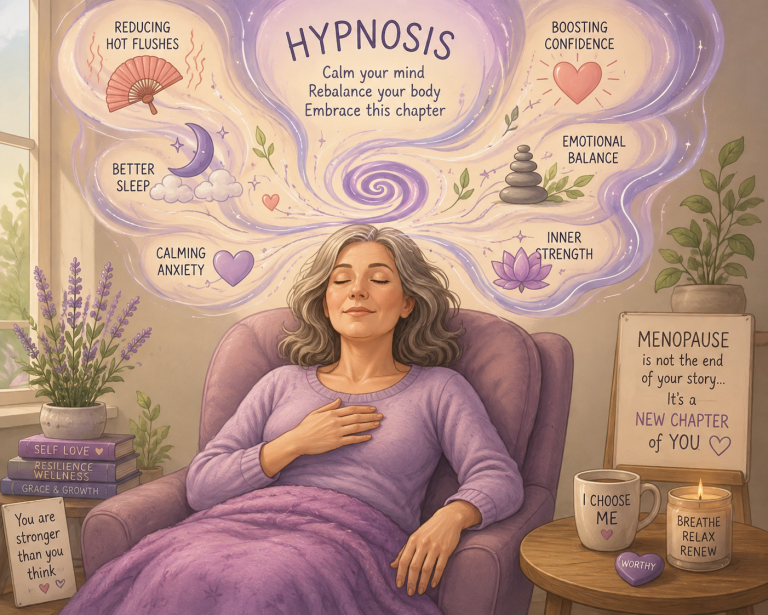
For women looking for alternatives or additional support during menopause, mind–body approaches such as mindfulness-based interventions and self-hypnosis may offer a useful option.
Research suggests that these approaches can help with a range of menopausal symptoms, including hot flushes and night sweats, sleep difficulties, psychological wellbeing and overall quality of life.
In particular, several studies included in this review reported improvements in vasomotor symptoms, with some suggesting that these benefits may extend into everyday life (John et al., 2022; Sener & Tashan, 2021; Aliabadi et al., 2021).
While these approaches are not intended to replace medical treatment where this is needed, they may provide an additional way of supporting wellbeing and helping women feel more able to manage the physical and emotional changes associated with menopause.